
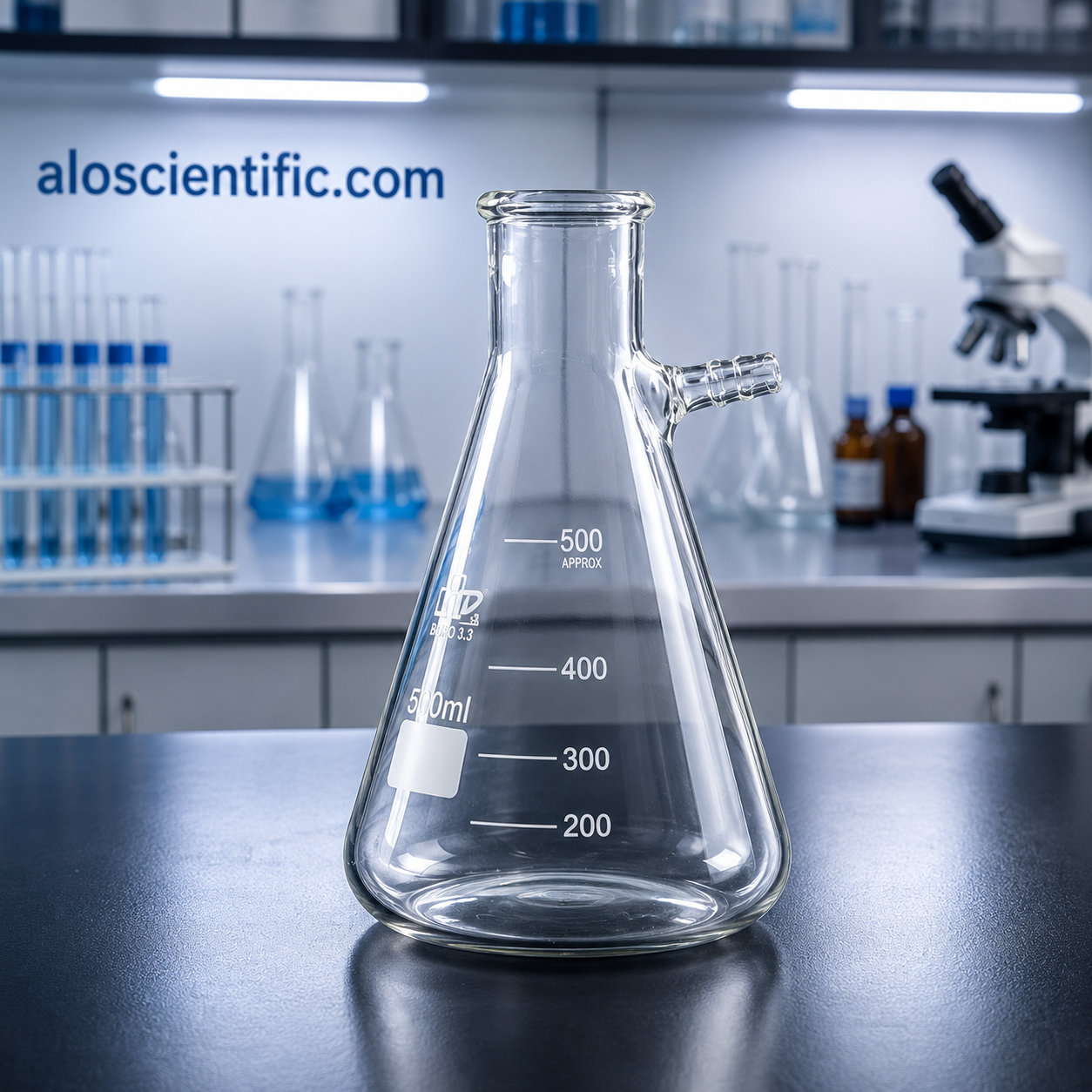
Filtering Flask is an essential piece of laboratory glassware commonly used for vacuum filtration, liquid separation and sample preparation. Its strong flask body and side-arm connection allow it to be connected to a suitable vacuum source, making filtration faster and more efficient than simple gravity filtration in many applications.
In Bangladesh, this type of laboratory glassware is commonly useful in chemistry, pharmaceutical, microbiology, research, educational and quality-control laboratories. A Laboratory Filtering Flask is particularly useful when a laboratory needs to separate solid particles from a liquid using a suitable filter paper, membrane or Büchner funnel.
Filtering Flask – Long Description
A Filtering Flask, also known as a FilterFlask or commonly a Büchner flask, is designed specifically for filtration applications. The flask generally features a thick-walled glass body and a side-arm outlet that can be connected to a vacuum tubing system.
During vacuum filtration, a suitable funnel and filter medium are positioned above the flask. The liquid passes through the filter while the solid particles remain on the filter surface. Vacuum pressure helps draw the liquid into the flask, making the filtration process more efficient.
Strong Laboratory Glass Construction
A quality Filtering Flask is manufactured from laboratory-grade glass designed for regular laboratory use. The glass body provides good visibility of the collected filtrate, allowing users to observe the liquid during and after filtration.
Laboratory glassware should always be inspected before use. If cracks, chips or other damage are visible, the flask should not be used, particularly under vacuum.
Side-Arm Design
The side arm is one of the most important features of a Vacuum FilteringFlask. It provides the connection point between the flask and the vacuum source.
A suitable vacuum tube can be connected to the side arm according to the equipment specification. When vacuum is applied, pressure inside the flask is reduced, helping pull liquid through the filter medium.
Proper tubing and compatible vacuum equipment should always be used to ensure safe operation.
Vacuum Filtration
The main application of the FilteringFlask is vacuum filtration. Compared with ordinary gravity filtration, vacuum filtration can provide faster liquid separation when the procedure and equipment are suitable.
A typical setup may include a Filtering Flask, Büchner funnel, filter paper or membrane, rubber adapter and vacuum pump or aspirator.
The exact setup depends on the sample and filtration procedure.
Useful for Solid-Liquid Separation
The flask is especially useful when separating suspended or precipitated solids from liquids. During laboratory experiments, chemical reactions may produce solid precipitates that need to be collected or separated.
The filtration process allows the liquid portion, known as the filtrate, to collect inside the flask while the solid material remains on the filter.
This makes the Filter Flask useful in many chemistry and research applications.
Sample Preparation
Filtering is often an important part of sample preparation. Before analysis, a liquid sample may need to be clarified by removing suspended particles or unwanted solid material.
A Laboratory Filtering Flask provides a convenient collection vessel during this process. It can be incorporated into laboratory workflows involving chemical testing, environmental samples, research samples and other compatible liquids.
Applications
Filtering Flask can be used across a variety of laboratory environments, including:
- Chemistry laboratories
- Pharmaceutical laboratories
- Research laboratories
- Educational institutions
- Quality-control laboratories
- Chemical processing laboratories
- Environmental testing laboratories
- Biotechnology-related applications
- General sample preparation
The exact application should always be matched with the flask’s material, capacity, vacuum rating and chemical compatibility.
Compatible Filtration Equipment
A Filtering Flask is commonly used with a Büchner funnel for vacuum filtration. Depending on the application, users may also use suitable membrane filtration assemblies or other compatible filtration funnels.
A rubber adapter or stopper may be required to create a proper seal between the funnel and flask. A good seal is important because vacuum filtration depends on maintaining the appropriate pressure difference.
Chemical Compatibility
Laboratory glass is compatible with many common laboratory chemicals, but it is not universally resistant to every chemical. Before use, users should check the chemical compatibility of the flask with the specific sample or reagent.
Highly aggressive chemicals, extreme temperatures and unusual operating conditions require additional consideration.
Cleaning and Maintenance
After filtration, the flask should be cleaned according to the laboratory’s standard procedure. Remove remaining solids and rinse the flask appropriately.
If the flask is reusable, inspect it before every use. Particular attention should be given to the side arm and flask walls because cracks or damage can become a safety concern during vacuum operation.
Avoid sudden temperature changes, especially when the flask is hot or cold. Proper storage also helps prevent accidental breakage.
Why Choose a Filtering Flask?
A Filtering Flask provides a dedicated solution for laboratory vacuum filtration. Its side-arm connection, stable flask design and clear glass construction make it practical for routine filtration and sample preparation.
For laboratories in Bangladesh looking for dependable laboratory glassware, a suitable Filtering Flask can be an important addition to the filtration setup.
Specifications
| Specification | Details |
|---|---|
| Product Name | Filtering Flask |
| Product Type | Laboratory Filter Flask |
| Alternative Name | Vacuum Filtering Flask / Filter Flask |
| Material | Laboratory-Grade Glass* |
| Design | Heavy-Wall Flask with Side Arm |
| Main Application | Vacuum Filtration |
| Filtration Type | Solid-Liquid Separation |
| Connection | Side-Arm Vacuum Connection |
| Compatible Equipment | Büchner Funnel / Suitable Filtration Funnel |
| Use | Filtration & Sample Preparation |
| Visibility | Transparent Glass |
| Application Areas | Research, Chemical, Pharmaceutical & Educational Labs |
| Maintenance | Clean and Inspect After Use |
*Exact glass type, capacity, wall thickness, side-arm dimensions and other specifications may vary according to the selected model. Please verify the actual product specification before purchase.
Key Features
- Designed for vacuum filtration
- Suitable for solid-liquid separation
- Durable laboratory glass construction
- Side-arm connection for vacuum tubing
- Compatible with suitable Büchner funnels
- Clear body for easy observation of filtrate
- Useful for laboratory sample preparation
- Suitable for research and educational laboratories
- Practical for pharmaceutical and chemical applications
- Reusable when properly cleaned and maintained
FAQ
1. What is a FilteringFlask?
A Filtering Flask is laboratory glassware designed primarily for vacuum filtration. It usually has a side arm for connecting the flask to a vacuum source.
2. What is another name for a FilteringFlask?
It is commonly called a Filter Flask, Vacuum Filtering Flask, or Büchner Flask.
3. What is a Filtering Flask used for?
It is mainly used for vacuum filtration and solid-liquid separation. It can also be useful for sample clarification and preparation.
4. Can a Filtering Flask be used with a Büchner funnel?
Yes. A Filtering Flask is commonly paired with a compatible Büchner funnel and filter paper for vacuum filtration.
5. How does vacuum filtration work?
A vacuum source creates reduced pressure inside the flask. This pressure difference helps pull liquid through the filter medium while retaining solid particles on the filter.
6. Is Filtering Flask suitable for chemical use?
Laboratory glass is compatible with many common chemicals, but compatibility depends on the specific chemical, concentration and temperature. Always verify compatibility before use.
7. Can the flask be reused?
Yes, if the particular model is designed for reusable laboratory use. It should be properly cleaned and carefully inspected for cracks or damage before reuse.
8. Can it be heated?
Some laboratory glass Filtering Flasks may tolerate controlled heating, but vacuum filtration flasks should not be assumed suitable for heating unless the manufacturer specifically states so. Never expose a flask under vacuum to unsuitable heating conditions.
9. Why is the side arm important?
The side arm allows connection to a vacuum source, which is essential for vacuum-assisted filtration.
10. What should I check before buying?
Check the capacity, glass type, side-arm size, wall thickness, vacuum suitability and compatibility with your filtration funnel and tubing before purchasing.
Reviews
There are no reviews yet.