
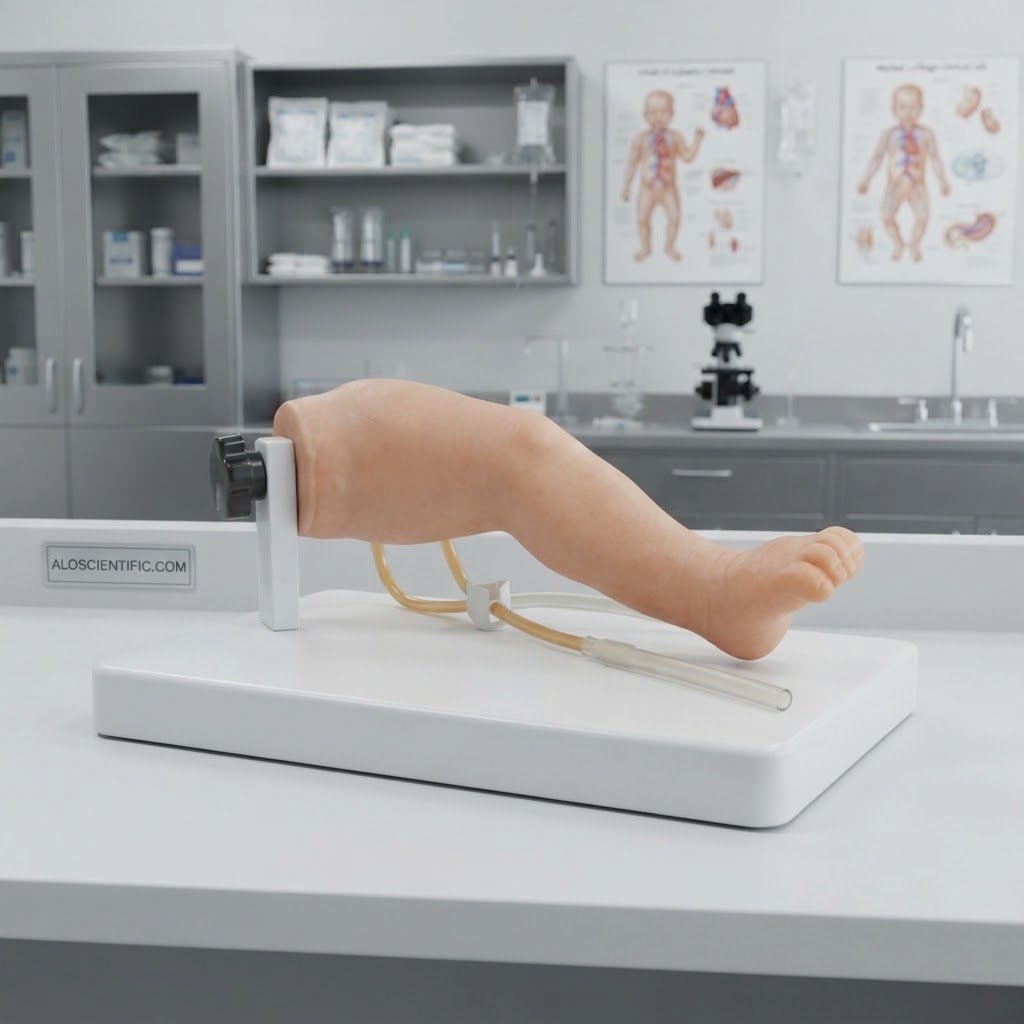
Introduction Advanced Infant Venipuncture Leg
The XC-485 Advanced Infant Venipuncture Leg is a specialized medical training simulator designed to support practical learning of venipuncture and intravenous (IV) access techniques in infant care. This educational model is suitable for nursing students, medical students, pediatric healthcare professionals, clinical instructors and healthcare training institutions that require a practical approach to learning infant venous access procedures.
Infant venipuncture requires precision, careful handling and a good understanding of pediatric anatomy. Infants have delicate tissues and small veins, making venous access a specialized clinical skill. তাই infant venipuncture শেখার জন্য proper training, hand coordination এবং careful technique খুবই গুরুত্বপূর্ণ। The XC-485 provides a training platform where learners can become familiar with procedural techniques before performing clinical procedures under appropriate supervision.
The Advanced Infant Venipuncture Leg is designed for classroom demonstrations, nursing skills assessments, simulation-based training and pediatric clinical workshops. It helps bridge the gap between theoretical knowledge and practical experience, allowing learners to develop familiarity with venipuncture procedures in a controlled learning environment.
For medical colleges, nursing institutes, hospitals and clinical skills laboratories in Bangladesh, this type of simulator can support practical pediatric nursing education and improve students’ understanding of infant venous access.
8. Product Overview Advanced Infant Venipuncture Leg
The XC-485 Advanced Infant Venipuncture Leg is an infant-specific training model intended for demonstrating and practising venipuncture techniques involving the leg. It can be incorporated into pediatric nursing and medical education programs where students need to understand the procedural workflow associated with infant venous access.
The model provides an opportunity for learners to practise relevant clinical skills, including equipment preparation, anatomical site assessment, procedural handling and post-procedure care. Instructors can demonstrate the basic principles of infant venipuncture and guide students through structured practical sessions.
শুধু বই পড়ে infant venipuncture শেখা অনেক সময় challenging হতে পারে। A practical simulator allows students to develop hand-eye coordination, understand procedural steps and receive feedback from instructors through repeated practice.
The XC-485 is intended for educational simulation and is not designed for performing actual medical procedures on infants. Its exact anatomical features, simulated vein arrangement and fluid circulation capabilities should be confirmed against the manufacturer’s specifications.
9. Key Features of XC-485 Advanced Infant Venipuncture Leg
-
Infant-specific training design: Designed to support the teaching of venipuncture techniques relevant to infant and pediatric nursing.
-
Leg venous access practice: Provides a dedicated model for demonstrating and practising venipuncture procedures involving the infant leg.
-
Practical clinical training: Helps learners become familiar with procedural steps and the handling of training equipment.
-
Simulation-based learning: Supports repeated practice in a controlled educational environment.
-
Nursing skills development: Helps develop hand coordination, procedural familiarity and confidence.
-
Instructor-led demonstration: Allows clinical educators to explain procedures and guide students through practical exercises.
-
Pediatric nursing application: Suitable for pediatric nursing education, medical colleges and healthcare training institutions.
-
Clinical skills assessment: Can be incorporated into supervised practical demonstrations and learner assessments.
-
Educational laboratory use: Appropriate for nursing skills laboratories, medical simulation centres and pediatric training facilities.
Specific features such as simulated blood circulation, replaceable veins, puncture sites and supplied accessories should be verified with the manufacturer.
10. Applications of Infant Venipuncture Training Leg
Pediatric Nursing Education
The Advanced Infant Venipuncture Leg is suitable for pediatric nursing courses where students learn the principles of infant venous access. It helps students understand the importance of anatomical knowledge, procedural accuracy and careful handling during infant care.
Medical College Practical Classes
Medical colleges can use the XC-485 for practical demonstrations, pediatric clinical skills classes and supervised simulation exercises. Instructors can explain the procedural sequence and discuss the precautions associated with infant venipuncture.
Hospital Training Programs
Hospital training departments can incorporate the Infant Venipuncture Training Leg into pediatric nursing workshops, refresher training and clinical skills development programs. It offers an educational setting for practising procedures without exposing real patients to training-related risks.
Nursing Skills Laboratories
Nursing institutes can use the XC-485 as part of practical training stations. Students can practise procedural techniques under the supervision of instructors and receive feedback to improve their performance.
Pediatric Clinical Workshops
The simulator can be used in workshops focusing on infant venous access, pediatric nursing procedures and clinical handling. It can also support group demonstrations and structured learning activities.
Medical Simulation Centres
Medical simulation centres can integrate the XC-485 into pediatric skills training programs. It can help instructors organize repeatable demonstrations and practical exercises for students at different levels of clinical education.
11. Learning Benefits
The XC-485 Advanced Infant Venipuncture Leg supports the development of essential practical skills in pediatric nursing and medical education.
-
Improved hand-eye coordination: Helps learners coordinate their visual assessment with precise hand movements during simulated procedures.
-
Procedural familiarity: Repeated practice helps students understand the sequence of venipuncture.
-
Anatomical understanding: Supports discussions about infant leg anatomy and the considerations involved in selecting an appropriate venous access site.
-
Clinical confidence: Supervised simulation can help reduce hesitation and improve familiarity before clinical placement.
-
Safe learning environment: Allows students to practise and correct mistakes without putting actual patients at risk.
-
Technical skills: Helps learners become familiar with the handling of training equipment and the procedural workflow.
-
Professional responsibility: Provides an opportunity to discuss hygiene, infection prevention, patient comfort and safe clinical practice.
-
Instructor feedback: Enables teachers to assess technique, explain errors and guide learners toward improvement.
Infant venipuncture training-এ শুধু technical skill নয়, patient safety, infection control এবং proper clinical communication-ও গুরুত্বপূর্ণ। The simulator can help instructors incorporate these principles into practical lessons.
12. How to Use the XC-485 Advanced Infant Venipuncture Leg
The model should be used according to the manufacturer’s instructions and under suitable instructor supervision.
-
Prepare the training area: Place the XC-485 on a clean, stable surface in a suitable medical skills laboratory.
-
Introduce the procedure: Explain infant venipuncture principles, relevant anatomy and the required safety precautions.
-
Prepare the equipment: Arrange the training instruments needed for the simulation according to the institution’s training protocol.
-
Demonstrate the technique: The instructor explains the procedural sequence, including preparation, site assessment and simulated venous access.
-
Practise the procedure: Students practise the relevant techniques on the model under appropriate supervision.
-
Evaluate performance: Instructors provide feedback on handling, coordination, procedural steps and adherence to infection-prevention principles.
-
Complete the training session: Review key learning points and discuss common challenges in infant venous access.
-
Clean and store: Follow the manufacturer’s cleaning and storage instructions to maintain the simulator.
Actual infant venipuncture must only be performed by appropriately trained healthcare professionals in a suitable clinical environment with proper authorization and supervision.
13. Specifications of XC-485 Advanced Infant Venipuncture Leg
|
Specification |
Details |
|---|---|
|
Product Model |
XC-485 |
|
Product Name |
Advanced Infant Venipuncture Leg |
|
Product Type |
Infant Venipuncture Training Simulator |
|
Training Category |
Pediatric Nursing and Clinical Skills |
|
Application |
Infant Venipuncture and IV Access Practice |
|
Anatomical Design |
Infant Leg |
|
Training Method |
Simulation-Based Practical Learning |
|
Intended Users |
Nursing Students, Medical Students, Clinical Instructors |
|
Suitable For |
Nursing Colleges, Medical Colleges, Hospitals, Skills Labs |
|
Educational Purpose |
Demonstration, Practice and Skills Assessment |
|
Reusability |
Subject to Manufacturer’s Instructions |
|
Brand |
As Supplied |
|
Origin |
As Supplied |
|
Warranty |
As Per Supplier Policy |
Note: Exact dimensions, weight, material, vein configuration, simulated blood circulation, included accessories and warranty should be confirmed from the manufacturer’s specifications.
14. Why Choose XC-485 Advanced Infant Venipuncture Leg?
Selecting the right pediatric venipuncture simulator is important for institutions that provide practical nursing and medical education. The XC-485 offers a dedicated infant leg training model that can be used to introduce venous access techniques in a structured learning environment.
Unlike theoretical teaching alone, simulation-based training gives students the opportunity to repeat procedures, develop coordination and receive direct feedback from instructors. It also allows educators to demonstrate the procedural workflow in a consistent manner.
For nursing colleges, medical colleges, hospitals and clinical skills laboratories in Bangladesh, the XC-485 can be a useful addition to pediatric nursing education. It supports practical learning while allowing institutions to organize supervised training sessions without using real patients for initial practice.
15. Importance in Pediatric Nursing Education
Infant venipuncture is a specialized clinical procedure that requires anatomical knowledge, technical precision and careful handling. The smaller size of infant veins and the delicate nature of infant tissues make appropriate training especially important.
The XC-485 Advanced Infant Venipuncture Leg helps educators introduce the challenges of infant venous access through simulation-based teaching. Students can practise relevant techniques, become familiar with clinical equipment and understand the importance of procedural safety before entering supervised clinical placements.
বাংলাদেশের Nursing College, Medical College এবং Hospital Training Centre-এ pediatric nursing practical education-এর জন্য এই ধরনের simulator গুরুত্বপূর্ণ ভূমিকা রাখতে পারে। Students can develop practical familiarity while instructors evaluate their techniques and provide constructive feedback.
The model can also support competency-based education by allowing students to demonstrate their understanding of preparation, procedural sequence, infection prevention and professional responsibilities.
16. Maintenance and Care
Proper maintenance is important to preserve the quality and usability of the XC-485 Advanced Infant Venipuncture Leg.
-
Clean the simulator using manufacturer-approved cleaning materials.
-
Avoid unnecessary pressure, rough handling and sharp objects that may damage the simulated skin.
-
Inspect the model regularly for visible wear or damage.
-
Replace consumable parts only according to the manufacturer’s instructions.
-
Store the simulator in a clean, dry and appropriate environment.
-
Keep it away from excessive heat and direct sunlight if specified by the manufacturer.
-
Follow the recommended maintenance schedule for any simulated venous system or replaceable components.
Regular inspection and appropriate care can help extend the useful life of the simulator and support consistent educational use.
17. Frequently Asked Questions (FAQ)
Q1. What is the XC-485 Advanced Infant Venipuncture Leg?
The XC-485 is a pediatric medical training simulator designed to help nursing and medical students practise infant venipuncture techniques involving the leg in a controlled educational environment.
Q2. Who can use the Infant Venipuncture Training Leg?
It is suitable for nursing students, medical students, pediatric nursing instructors, clinical educators and healthcare professionals participating in supervised training.
Q3. What is the main purpose of the XC-485?
Its main purpose is to support practical education in infant venous access, venipuncture techniques and pediatric nursing skills.
Q4. Is the XC-485 suitable for nursing colleges?
Yes. It is intended for educational simulation and can be used in nursing colleges, medical colleges, hospitals and clinical skills laboratories.
Q5. Can students practise IV injection techniques on this model?
The model is designed for infant venipuncture training. The exact IV practice capabilities depend on the supplied model’s design and the manufacturer’s specifications.
Q6. Does the XC-485 help improve clinical confidence?
Yes. Repeated, supervised simulation practice can help students become more familiar with procedural steps, improve hand coordination and develop confidence before clinical training.
Q7. Is the Advanced Infant Venipuncture Leg reusable?
It is intended as a training simulator. Reusability and the replacement requirements for consumable parts depend on the manufacturer’s care and maintenance instructions.
Q8. Can hospitals use the XC-485 for staff training?
Yes. Hospitals can consider it for pediatric nursing education, refresher courses, clinical skills demonstrations and supervised staff development programs.
Q9. What is the difference between an infant venipuncture arm and leg model?
An arm model is intended for practising and demonstrating venous access techniques involving the infant arm, while a leg model is designed for training related to the infant leg. The anatomical training focus differs between the two.
Q10. Can the XC-485 be used for actual infant treatment?
No. The XC-485 is an educational training simulator and is not intended for performing medical procedures on real infants.
Q11. Where can I buy the XC-485 Advanced Infant Venipuncture Leg in Bangladesh?
You can contact Alo Scientific through
to enquire about pricing, availability and ordering information.
18. Buy XC-485 Advanced Infant Venipuncture Leg in Bangladesh
If you are looking for an Advanced Infant Venipuncture Leg in Bangladesh, the XC-485 is a specialized training model to consider for pediatric nursing education, clinical skills development and medical simulation programs.
Alo Scientific supplies scientific, laboratory and medical education equipment for universities, hospitals, medical colleges, nursing institutes and diagnostic training centres. The XC-485 can be considered by institutions looking to strengthen their pediatric nursing skills laboratory with simulation-based training equipment.
Whether you are establishing a new nursing skills laboratory or upgrading an existing medical training facility, the XC-485 can support structured infant venipuncture demonstrations and supervised practical learning.
Contact Alo Scientific for product details, quotations, delivery information and availability in Bangladesh through

Reviews
There are no reviews yet.